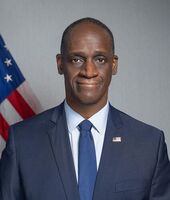
“Don’t look at countries like Bangladesh as a charity case. This is an investment case, and the opportunity is huge.” Mr. Andrew Herscowitz, CEO, RF Catalytic Capital. “We’re looking at how AI compute demand becomes an enabler for energy access, rather than a big suck on the grid.”
Sebastian Groh
“We’re looking at how AI compute demand becomes an enabler for energy access, rather than a big suck on the grid.”
Andrew Herscowitz
“One of the reasons that I love working in sustainability is when you save carbon, you save cost.”
Suzanne DiBianca
“Scale for AI is not an enemy of expanding access, and in fact, sometimes when you bring two problems together, there are more opportunities.”
Kathryn Clay
Key Takeaways
The panel looked at two major grid challenges together, bringing electricity to people who lack it and managing the surge in demand from data centers, arguing that combining them can create new solutions rather than competing needs.
Herscowitz described how the Mission 300 Accelerator is testing shipping containers of GPUs at off-grid solar mini-grids in Africa, where 560 million people still lack electricity, so that unused power can be sold as AI compute over fiber or Starlink, lowering costs and making mini-grids investable, with a “community first” rule so local needs always come before compute.
Groh called the focus on data centers a “policy blind spot,” citing International Energy Agency data showing that in Asia, air conditioning (10–11%) and EVs (13%) account for far more electricity demand than data centers (3%), and noting that in Bangladesh electric three-wheelers make up a third of demand while load shedding can reach 19 hours a day outside Dhaka.
He proposed that instead of building centralized power plants, tech companies could fund energy efficiency and rooftop solar for local communities, such as heat pumps at 20 cents on the dollar, and receive credit for the power saved, which would build far more community support.
DiBianca said U.S. public sentiment toward data centers is largely negative, with over 20 states seeing local or statewide moratoriums, and that Salesforce is shifting non-urgent workloads to off-peak hours and investing in startups like Emerald AI that move data center loads between regions to ease grid stress, though customer data residency rules limit where compute can happen.
Groh showed the power of distributed storage, explaining that Bangladesh’s six million electric tuk-tuks, each holding about a kilowatt, could form a virtual power plant that buffers 10–30% of the national grid more cheaply than building large battery storage plants, a lesson that Western countries could learn from.
Each panelist named one barrier to remove, with DiBianca pointing to the U.S. permitting backlog, Groh urging investors to see countries like Bangladesh as an investment case rather than a charity case, and Herscowitz calling for catalytic concessional and grant capital to cover high upfront GPU costs that can be recovered in one to three years.
Action Items
Developers and funders should pilot and scale AI compute at off-grid mini-grids, with operating rules that guarantee local communities are served first.
Tech companies should invest in community energy efficiency and rooftop solar programs as an alternative to building new centralized power plants, and policymakers should create ways to credit them for the power saved.
Policymakers should address electricity demand from air conditioning and EVs alongside data centers when planning grid capacity.
Companies using cloud computing should shift non-urgent workloads across time and regions to reduce peak strain on the grid.
Utilities and regulators should enable virtual power plants that aggregate EV batteries to support the grid during peak hours.
U.S. lawmakers should pursue bipartisan permitting reform, while funders deploy catalytic concessional capital to prove out models that can then attract private investment in emerging markets.