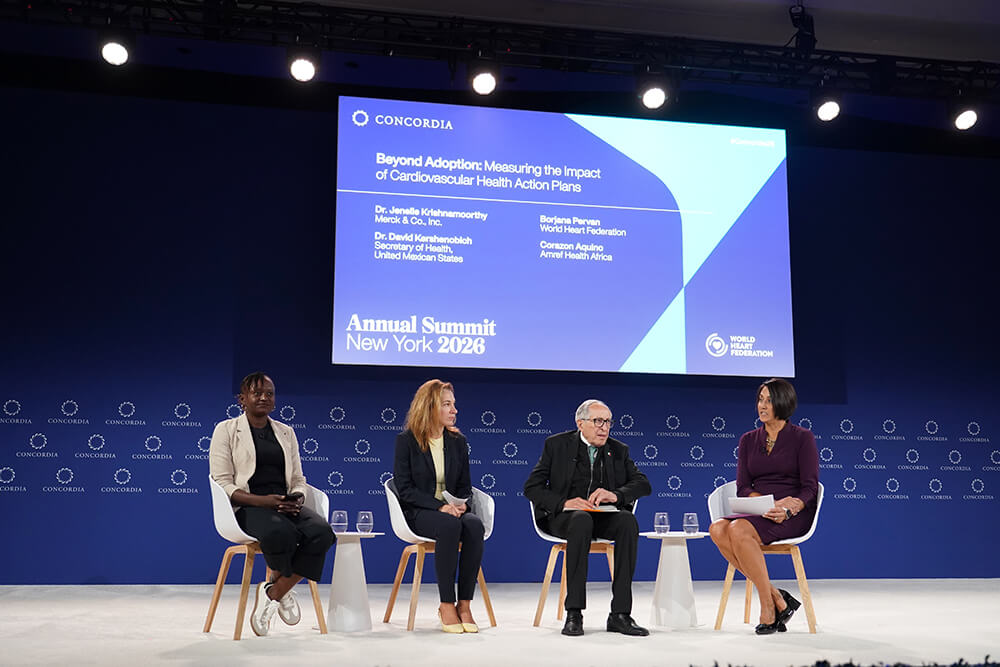
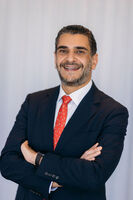
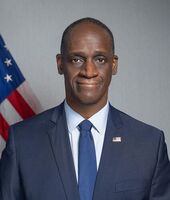
NEW YORK, NEW YORK – SEPTEMBER 22: (L-R) Corazon Aquino, Director of Partnerships at Amref Health Africa, Borjana Pervan-Shtilianov, CEO of the World Heart Federation, Dr. David Kershenobich, Secretary of Health of Mexico, and Dr. Jenelle Krishnamoorthy, SVP of Global Policy and Public Affairs at Merck, speak during the 2026 Concordia Annual Summit at Sheraton New York Times Square on September 22, 2026 in New York City. (Photo by Leigh Vogel/Getty Images for Concordia Summit)
Important Quotations
“I always speak about cardiovascular disease as... the chronicle of a death foretold. So I think that we, with the knowledge that we have... have a chance to make it a chronicle of a life saved.”
Borjana Pervan-Shtilianov
“If you impact the children in prevention, you will probably, in a couple of years, start to see a decrease in the burden of cardiovascular disease.”
Dr. David Kershenobich
“We should not just regulate food to keep us safe for that moment. It should be able to keep us safe for a very long time.”
Corazon Aquino
“The question before us is no longer, what should we do? The question is, how do we translate knowledge into action and action into measurable impact?”
Dr. Jenelle Krishnamoorthy
Key Takeaways
Cardiovascular disease is the world’s leading cause of death, killing nearly 40 people every minute, and most of it is preventable. Recent momentum includes the UN political declaration on NCDs, the WHO stroke resolution, the EU Safe Hearts Plan, new U.S. cholesterol guidelines, and upcoming WHO cholesterol guidance. But commitments mean little unless plans are funded and measured.
In Mexico, cardiovascular disease is the top cause of death, and patients are usually reached only once symptoms appear. Mexico is shifting toward prevention, including annual blood pressure checks in workplaces and communities. It also treats the related conditions as one “cardio-renal-metabolic” disease managed through primary care that reaches beyond the big cities.
The rising economic burden is driving Mexico’s prevention work with children. Ultra-processed food is now banned in schools, and the “Live Healthy, Live Happy” program aims to cut future disease through education and healthy habits that spread to families.
Policies covering whole populations can work quickly. South Africa’s mandatory salt reduction in supermarket foods is already showing measurable drops in high blood pressure, even though food regulation faces strong industry resistance.
Health workers are underprepared. A Kenya pilot run by AMREF with the Novo Nordisk Foundation found that only about 3% of nurse and clinician training covered cardiovascular disease, which led to new courses for nurses, clinicians, and community health promoters. Systems built for HIV, TB, and malaria can also be used for heart disease.
The World Heart Federation found that fewer than 20 countries among its members have a dedicated cardiovascular health plan, and many of those plans are not fully funded or measured. With costs above $1 trillion once lost productivity is counted, cardiovascular health needs whole-of-government attention, not just the health system’s.
Finland’s North Karelia project shows what lasting success looks like. Government, industry, and communities worked together to cut salt, fat, and smoking, and progress was measured consistently across decades and changes of government.
Action Items
Governments should adopt dedicated cardiovascular health plans that are costed, funded, and have clear targets. Progress should be tracked consistently across changes of government, using tools such as the World Heart Federation’s Framework for Action.
Make cardiovascular screening and management part of primary care, including routine annual blood pressure checks in workplaces and communities, and build on existing infectious disease delivery systems.
Pass food policies that reach whole populations, such as mandatory salt reduction and limits on ultra-processed food in schools.
Update training for nurses, clinicians, and community health workers so they can detect, advise on, and manage cardiovascular disease.
Manage blood pressure, cholesterol, blood sugar, obesity, and kidney disease together as linked cardio-renal-metabolic conditions rather than separately.
Break down silos by bringing cardiovascular health into economic, security, and finance discussions, and involve industry, civil society, and communities in delivery.