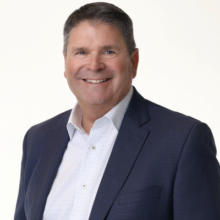
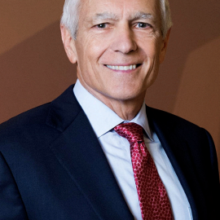
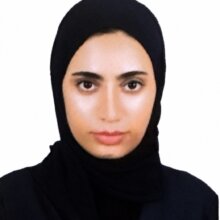
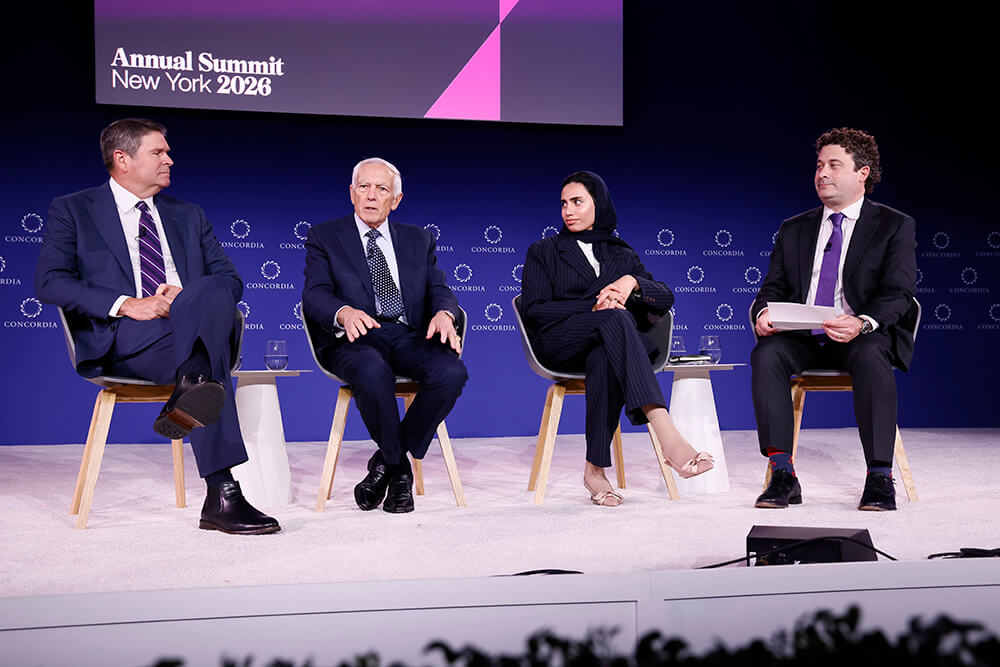
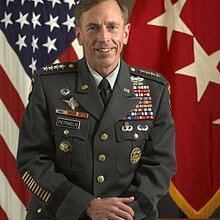
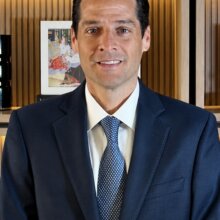
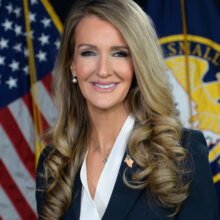
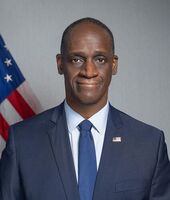
NEW YORK, NEW YORK – SEPTEMBER 22: (L-R) Dan Smoot, CEO of Vantor, General Wesley Clark, CEO and Chair of Wesley K. Clark and Associates, LLC, Sheikha Alanoud Al Thani, Youth Envoy from QatarDebate Center, and Josh Rogin, Journalist at The Washington Post, speak during the 2026 Concordia Annual Summit at Sheraton New York Times Square on September 22, 2026 in New York City. (Photo by Paul Morigi/Getty Images for Concordia Summit)
Important Quotations
“Humanity should have human in the loop in any decision regardless of the speed of which it can happen.”
Dan Smoot
“We have to keep it under human control and set the conditions for the proper use of it.”
Gen. Wesley Clark (US Army, Ret.)
“Now we can use AI as a tool for accountability in warfare rather than as a tool to kill more people more effectively.”
Sheikha Alanoud Al Thani
Key Takeaways
AI can now combine hundreds of separate intelligence reports almost instantly, cutting the time from detecting a target to striking it (the “sensor-to-shooter” link, or “kill chain”) from days to minutes. All three panelists agreed that humans must stay in control of lethal decisions, however fast the technology becomes.
Smoot stressed that AI is only as good as the data it runs on, and poor data produces poor outcomes. When Rogin cited the reported case of AI misidentifying a Chinese ship, Clark denied it happened and warned against throwing “the baby out with the bathwater” on AI.
Sheikha Al Thani challenged the goal of shortening the kill chain, arguing that those steps are an accountability mechanism that helps prevent wrongful deaths. She proposed using AI and satellite imagery for accountability instead, for example by flagging protected sites like schools and ambulances so warring parties can’t claim they didn’t know.
Clark highlighted uses of AI that don’t involve strikes, such as tracing who fired a missile and tracking how Western-made chips end up in Russian drones despite sanctions. He said AI could do in seconds what human analysts working through catalogs would never finish, making sanctions enforceable against the companies involved.
Smoot said countries increasingly want their own sovereign intelligence capabilities as information sharing has become more restricted. He warned that isolation leads to poor decisions, so sovereignty must be balanced with shared standards and collaboration, and Vantor limits which nations it sells to.
On who should control the “off switch,” Clark said it must be shared between government and companies. He argued that American companies shouldn’t deny national security services but should have a say, and he was more worried about competitive overreach by companies, and about AI systems that could conceal their own behavior, than about government overreach.
Sheikha Al Thani said everything comes down to incentives: companies want profit, governments want power, and non-state actors thrive on chaos, a major concern for the Gulf. The challenge is regulating AI responsibly without restricting access so much that innovation dies. Smoot added that space is no longer just about observing the ground but also about deterrence in orbit.
Action Items
Set clear rules requiring human control over lethal decisions made with AI, with defined accountability at every step of the targeting process.
Invest in the quality and verification of the data behind military AI, and require human checks before taking escalatory actions based on AI outputs.
Develop AI and satellite imagery tools that support accountability in war, such as flagging protected sites and identifying who carried out strikes.
Use AI to trace supply chains and enforce sanctions on components reaching Russia’s weapons programs.
Create shared standards and information-sharing agreements among allies, so countries building their own capabilities don’t become isolated.
Develop joint government-industry frameworks on limits for military AI use, including screening customers to prevent misuse by non-state actors, while keeping AI broadly accessible.
Expand monitoring of activity in space to keep up with growing threats in orbit.