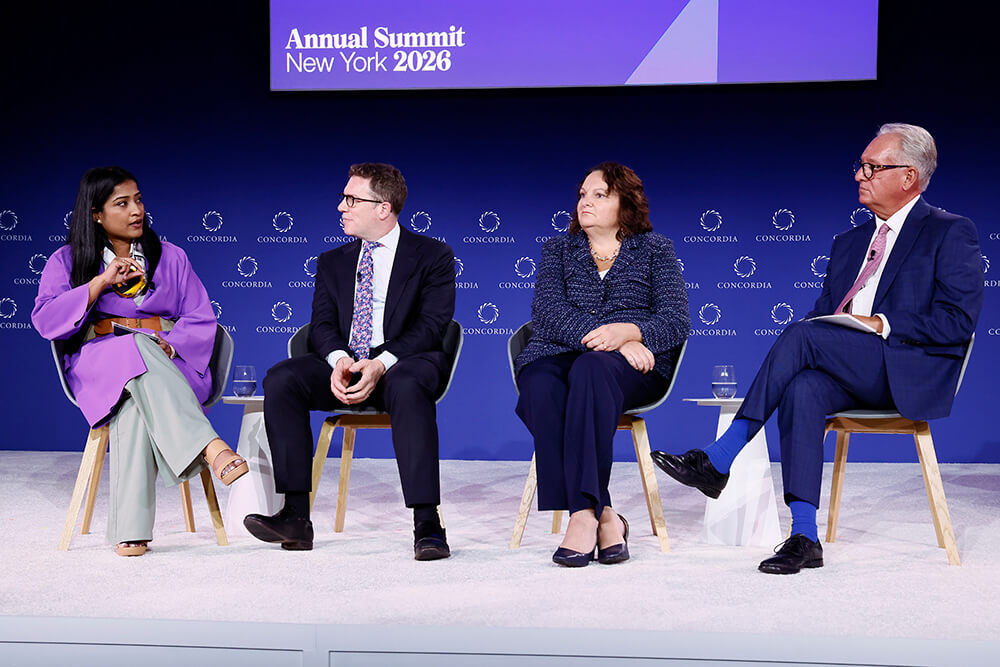
NEW YORK, NEW YORK – SEPTEMBER 21: (L-R) Asha Varghese, Head Of Corporate Social Responsibility at Caterpillar Inc., Ben Smith, Co-Founder and Editor-in-Chief at Semafor, Maria Flynn, CEO of Jobs for the Future, and Douglas Evans, President and CEO of Palm Beach Chamber of Commerce, speak during the 2026 Concordia Annual Summit at Sheraton New York Times Square on September 21, 2026 in New York City. (Photo by Paul Morigi/Getty Images for Concordia Summit)
Important Quotations
“A 10% increase in the value of a superstar is a lot more valuable than hiring 30 new people.”
Ben Smith
“For decades we have looked at talent as a byproduct of economic growth, and I think that equation is shifting very much today — talent is the future of growth.”
Asha Varghese
“We’ve always been looking for ways to build better bridges between learning and work, and now’s the time to really make that bridge even more stable and agile, so that we can continue to be changing together as everything around us changes.”
Maria Flynn
Key Takeaways
Talent has shifted from a byproduct of economic growth to its engine. The core problem is less about creating jobs than creating pathways to them, as shown by the 2,000 high-paying jobs currently unfilled in Palm Beach County.
Training pathways are fragmented, often unaffordable, and built on an outdated linear model of “get educated, get a job.” Fast technological change now requires continuous reskilling and upskilling throughout a career.
CEOs largely say AI is adding work rather than replacing workers. However, workforce structures are shifting from a “triangle” to a “diamond,” putting traditional entry-level roles, and the on-the-job learning they provided, at risk.
Durable human skills such as problem-solving, teamwork, and critical thinking are becoming more valuable. Young people also build them outside the classroom, through part-time jobs, caregiving, scouting, and 4-H.
Training programs fail without wraparound support. Transportation, child care, and even a trainee’s ability to pay a cell phone bill can determine whether people actually complete training.
Manufacturing and the skilled trades face a perception problem. These are high-quality, high-paying jobs, but families, counselors, and educators often see them through a lens of fear about AI and automation.
Core systems lag behind the moment. The federal workforce system was built for the New Deal era, employers must move from talent “consumers” to co-creators, and states have a real opening to innovate.
Action Items
Ensure every high school student completes a structured work-based learning experience before graduating, such as a paid internship, youth apprenticeship, or high-quality virtual placement.
Build place-based coalitions in which employers co-design curricula, training labs, and hands-on experiences with K–12 schools, community colleges, and local government.
Fund wraparound services alongside every training investment, including transit access, child care, connectivity, and social financing, informed by local data like commuter maps.
Launch perception-shift campaigns aimed at families, school counselors, and educators that show modern manufacturing and the trades as smart, tech-forward, well-paid careers.
Develop apprenticeships and education-based pathways that replace the on-the-job training once delivered through entry-level roles now being absorbed by AI.
Advocate for federal workforce system reform focused on lifelong learning, career navigation, and less bureaucracy, while encouraging governors to use existing flexibility to move quickly.