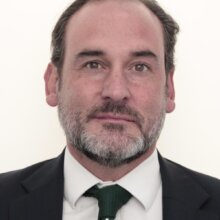
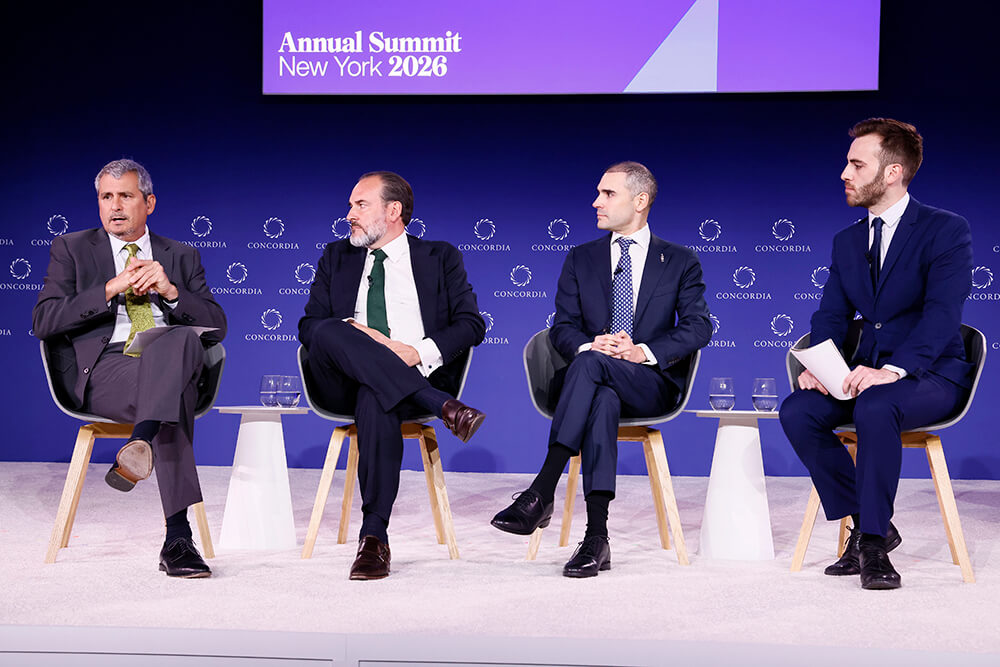
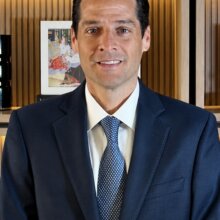
NEW YORK, NEW YORK – SEPTEMBER 22: (L-R) Mark Viso, President and CEO of Food For the Hungry, Ignacio Corlazzoli, Manager for Resource Mobilization and Global Alliances at CAF, Sergio Londoño, VP of Public Affairs, Communications and Sustainability at The Coca Cola Company, and Roberto Macedonio, Correspondent for NTN24, speak during the 2026 Concordia Annual Summit at Sheraton New York Times Square on September 22, 2026 in New York City. (Photo by Paul Morigi/Getty Images for Concordia Summit)
Important Quotations
“The future lies in the power that we as a society harness when public sector, private sector, multilateral organizations and civil society come and work together.”
Sergio Londoño
“Not only is this a challenge, but it’s an opportunity and even perhaps a responsibility… to reimagine how we help people come out of poverty and overcome injustice.”
Mark Viso
“We need to work at the end for the most humble people, the ones who really need us.”
Ignacio Corlazzoli
Key Takeaways
Lasting investment in Latin America depends on being deeply rooted in local communities, as Coca-Cola has done over 120 years in the region by buying about $15.9 billion a year from local suppliers, supporting small store owners, and accounting for roughly 0.8% of Colombia’s GDP.
The multilateral system is in crisis, and development banks need to be reshaped to become more humble, agile, and focused on execution, especially as traditional donors like the U.S. and Nordic countries cut aid while new partners such as Qatar, India, and Indonesia step in.
Corlazzoli described Latin America and the Caribbean as the “solution region” because of its minerals, solar potential, and water resources, with CAF expanding into new sectors like gas, nuclear, and energy for AI and using new tools such as blended finance and de-risking to bring in private capital.
Latin America is the world’s second most disaster-prone region, and repeated shocks can wipe out the value of investments overnight, which is why Food for the Hungry is promoting a “resilience economy” built on investable portfolios, shared platforms, and common metrics to measure resilience, starting with a national resilience map in Guatemala.
Coca-Cola and CAF created a new blended finance model for rebuilding Chocó, Colombia, after the earthquake, funding the technical work of designing projects rather than just construction, because, as Londoño put it, there are no bricks without plans.
Systemic thinking reveals the real root of problems, as with schools in Mexico where the true barrier to learning was water access, leading Coca-Cola to install 1,500 rainwater harvesting systems in public schools, and AI offers a new opportunity to break down silos.
All panelists agreed that progress depends on the public sector, private companies, multilateral banks, and civil society working together, with CAF playing a key convening role through events like its forum in Panama on January 27–28.
Action Items
Companies should partner with development banks through blended finance to fund project preparation and technical assistance, not only physical construction.
Development organizations, banks, and governments should create common metrics to measure resilience so it can be valued and compared across investments.
Development banks should reform to become faster and more execution-focused, expanding de-risking tools that draw in private investment.
Latin American institutions should actively engage new funding partners from the Gulf and Asia to help fill the gap left by declining traditional aid.
Investors and development groups should diagnose root causes systemically before designing interventions, with water access as a priority in many communities.
Stakeholders should use AI and shared digital platforms to connect public, private, and civil society efforts, and take part in CAF’s January forum in Panama.