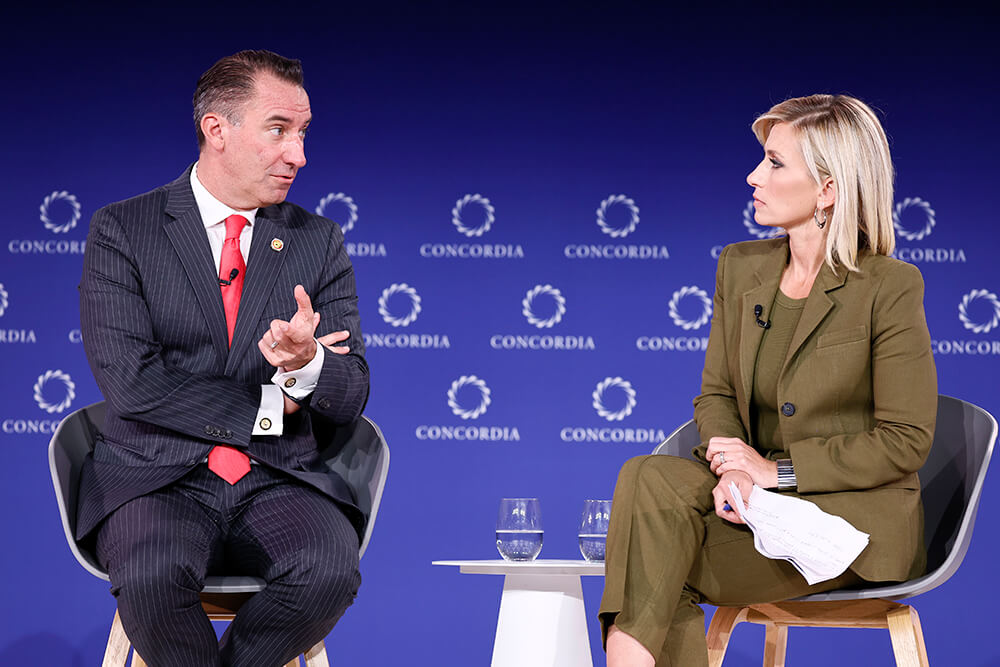
NEW YORK, NEW YORK – SEPTEMBER 22: Jarrod Agen, Assistant to the President and Executive Director of the NEDC, and Morgan Brennan, Anchor at CNBC, speak during the 2026 Concordia Annual Summit at Sheraton New York Times Square on September 22, 2026 in New York City. (Photo by Paul Morigi/Getty Images for Concordia Summit)
Key Takeaways
Agen described the Western Hemisphere, from Alaska to Argentina, as the new center of affordable, reliable, and secure energy, with supply chains running from Latin America to the Gulf of America, from Alaska to Asia, and from the U.S. to Europe and through the Panama Canal, alongside work with Colombia, Argentina, and Ecuador and a changed relationship with Venezuela.
He said the investment is already there and the main obstacle is the slow permitting process and lawsuits that stall projects, making permitting reform a top priority with Congress.
The administration is using government equity partnerships to signal long-term commitment, including what Agen called the biggest U.S. oil deal ever, a 100-year Department of War partnership in Venezuela in which the U.S. receives 55% of the oil, as well as equity stakes in mining companies and a new road in Alaska to open up mining.
Agen expects Venezuelan oil output to ramp up quickly and hit record levels, led by incumbents like Chevron and Eni and newer independents like Continental Resources, as part of a full restart of the country’s telecom, banking, transportation, and electrical grid.
He called the electrical grid the “undertold story” in both Venezuela and the U.S., since regions near power generation like Pennsylvania and Texas are well positioned while places like New England are already at their limit as data center demand grows.
In the Middle East, Agen said crude is getting through the Strait of Hormuz, but the long-term goal is to reduce dependence on it by building more bypass pipelines, similar to how the U.S. helped create corridors to bring LNG into Central and Eastern Europe.
Agen identified refining as the global bottleneck behind record diesel prices, with Russia’s capacity down 30–40% and U.S. refineries at nearly 100%, and said the administration opposes a diesel export ban and expects a nuclear energy renaissance over the next five to 10 years.
Action Items
Congress should pass permitting reform that shortens approval timelines and limits project delays from litigation.
The U.S. and partner countries should invest in modernizing electrical grids, especially in regions facing growing demand from data centers.
The U.S. and Gulf partners should build new pipelines and expand existing ones to reduce reliance on the Strait of Hormuz.
Policymakers should increase U.S. refining output through regulatory relief and new storage and pipeline infrastructure.
Government and industry should use public-private partnerships to reduce the risk of investing in critical minerals and energy projects, and build a global alliance for mineral processing.
The U.S. should prioritize nuclear supply chains and technology to meet growing demand from states and international partners.