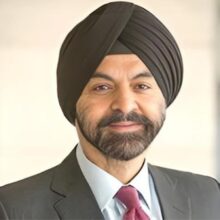
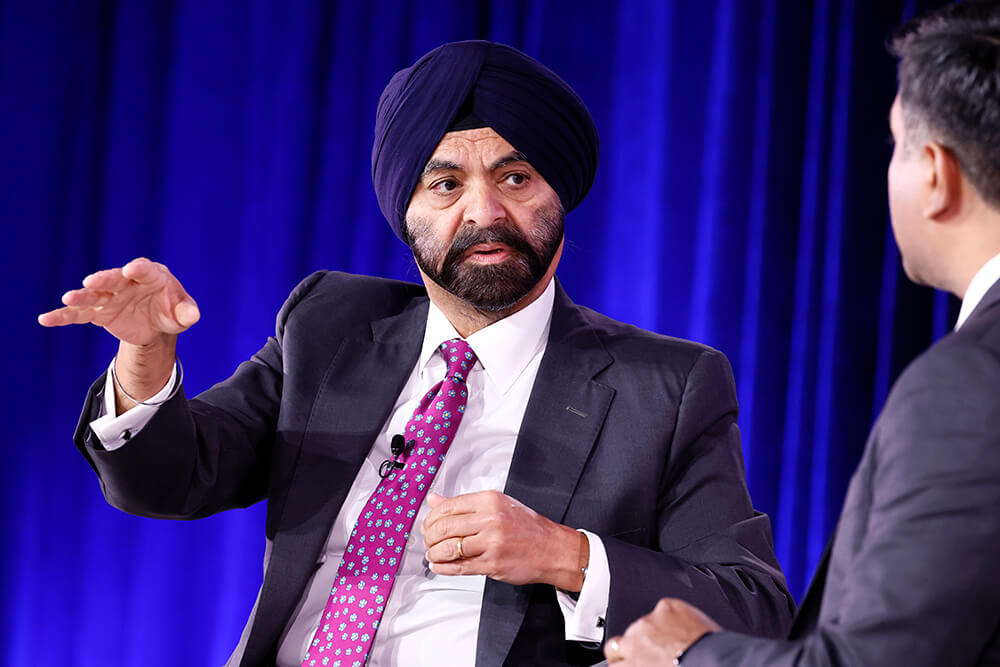
NEW YORK, NEW YORK – SEPTEMBER 21: Ajaypal Banga, President of the World Bank Group, speaks during the 2026 Concordia Annual Summit at Sheraton New York Times Square on September 21, 2026 in New York City. (Photo by Paul Morigi/Getty Images for Concordia Summit)
Important Quotations
“Typically, you would have had one part of the bank go talk to the government, one part of the bank go talk to Rio Tinto. Hopefully, they’re all talking to each other. And one day, kumbaya, some project will happen. Hope’s not a strategy.”
Ajay Banga
Key Takeaways
Jobs are central to fighting poverty. About 1.2 billion young people in emerging markets will reach working age in the next 12–15 years. Banga defines a “job” broadly to include small farmers, entrepreneurs, and micro-enterprises. He argues that jobs provide dignity and hope, which handouts alone cannot.
Governments enable jobs, but the private sector creates them.
Many countries value the Bank’s knowledge and policy advice as much as its money.
Private capital mobilization has roughly tripled. It grew from about $30 billion three years ago to $112 billion this fiscal year. The drivers were: regulatory clarity, political risk insurance, which has more than quadrupled, local currency financing, now about 35% with a 40% target, and a first-loss/capped-return fund.
The next frontier is turning emerging-market projects into an asset class. This means bundling standardized, credit-rated projects so pension funds, insurers, and asset managers can invest at scale. Banga places this at an early stage, “3 or 4 out of 10.”
The Bank is working as one integrated institution. Its public, private (IFC), guarantee (MIGA), and dispute-settlement (ICSID) arms are coordinating rather than operating in silos. The Argentina lithium project with Rio Tinto is the example: roads, ports, skills training, and investor guarantees were planned together.
AI is a productivity tool, not a job threat, in emerging markets. Exposure to large language models is estimated at up to a third of jobs in developed economies but is negligible in low-income countries. Simpler predictive AI is already helping illiterate farmers in Uttar Pradesh diagnose crop disease and supporting primary health clinics in Indonesia and El Salvador.
Job creation is focused on five less AI-exposed sectors. These are infrastructure/construction, smallholder agriculture, primary health care, tourism, and value-added manufacturing. Entrepreneurship support and small venture funds run across all five.
Action Items
Prioritize regulatory reform. Strengthen regulator independence and modernize bankruptcy, labor, land, and collateral law, using World Bank technical assistance, since regulatory clarity is the first condition investors cite.
Use the full de-risking toolkit to attract private investors. This includes political risk insurance, local currency financing, and first-loss or capped-return structures.
Accelerate the emerging-market asset class. Bundle and standardize projects, such as regional water portfolios, with credit ratings so institutional investors can participate at scale.
Plan large projects as integrated packages. Bring governments, private investors, and all Bank arms to the table from the start rather than negotiating in parallel.
Invest in digital public infrastructure first. Universal bank accounts and digitized health systems make low-cost, local-language AI tools possible in farming, health care, and education.
Build separate strategies for fragile and conflict-affected states. Private capital is not reaching these countries, so they need micro and small enterprise development, entrepreneurial centers, and small venture funds.
Align skilling and education with the five priority sectors. This ensures the incoming wave of young workers is prepared for the jobs being created.