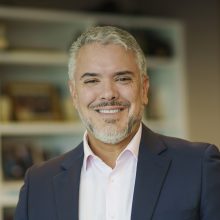
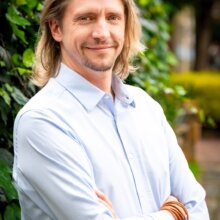
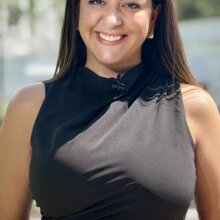
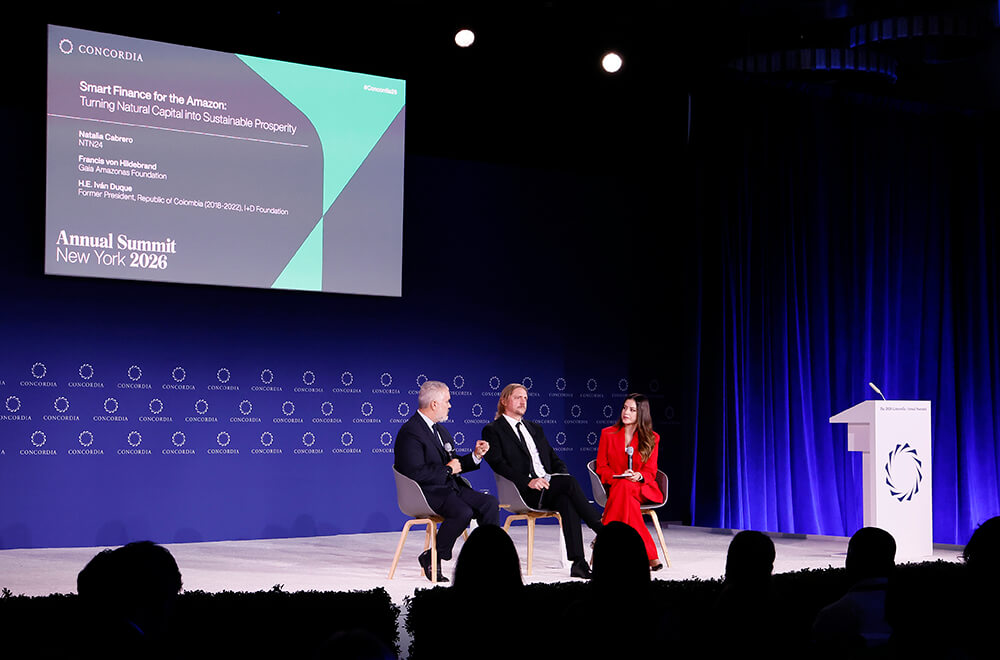
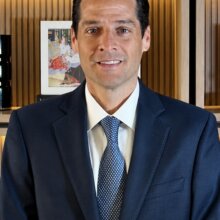
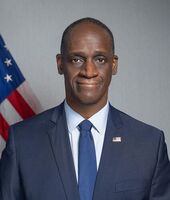
NEW YORK, NEW YORK – SEPTEMBER 21: (R-L) Ivan Duque Márquez, Former President of Colombia, Francis von Hildebrand, President of Gaia Amazonas, and Natalia Cabrera, Correspondent at NTN24, speak during the 2026 Concordia Annual Summit at Sheraton New York Times Square on September 21, 2026 in New York City. (Photo by Paul Morigi/Getty Images for Concordia Summit)
Important Quotations
“I’m convinced, I’m optimistic, and I think we all have to mobilize all our efforts, and it is to bring the Amazon to a zero deforestation condition.”
H.E. Ivan Duque
“Turning financial markets in service of nature instead of nature in service of financial markets.”
Francis von Hildebrand
“The Amazon does not lack value, and the world does not necessarily lack capital. So what is missing? What is missing is the bridge.”
Natalia Cabrera
Key Takeaways
The Amazon absorbs an estimated 10–15% of global greenhouse gas emissions and holds the world’s largest concentration of biodiversity, but it has lost about 23–25% of its area to deforestation, close to the 20–25% range scientists say could trigger a tipping point that turns it into a net emitter.
Von Hildebrand argued the Amazon should be seen as a “source, not a resource,” since a living forest is currently valued at zero, leaving extraction as the only way to profit, even though its “flying rivers” supply water for hydropower, agriculture, and drinking water for over a billion people across the Americas.
Through the Global Biodiversity Alliance launched with Guyana’s President Ali, Duque outlined a finance toolkit of country taxonomies, debt-for-nature swaps like Ecuador’s, guarantees for local governments, biodiversity credits, and fast-disbursing multilateral loans tied to conservation targets, with a goal of placing the first Amazon biodiversity bond within about two years.
Investors can lower their risk by building on existing political alignment among the eight Amazon countries through the Belém and Bogotá Declarations, the Leticia Pact, and the OTCA, along with satellite and community-based monitoring systems.
Credibility for private capital depends on science-based valuation of natural assets, especially water flows, along with transparency, sound carbon accounting, and clear metrics for what counts as “nature positive,” building on lessons from carbon markets.
Indigenous peoples directly manage 48% of the Amazon and their lands have the least deforestation, so both speakers stressed that they must be shareholders and core partners rather than beneficiaries, with investment flowing through Colombia’s formally recognized indigenous governments.
Duque announced the creation of ProAmazonía, a private sector initiative for Amazon conservation in Colombia expected by year’s end, and set zero deforestation as the measure of success in five years.
Action Items
Amazon countries should define national conservation taxonomies so the costs of protection are clear and financial instruments can be matched to them.
Governments and banks should launch one or two high-integrity, transparent financial instruments, such as an Amazon biodiversity bond, that can be placed in international markets.
Multilateral development banks should provide guarantees and lending, and help place and buy nature-based bonds as part of their treasury management.
Researchers and investors should develop science-based models to value the Amazon’s water flows and other natural assets, and agree on clear metrics for nature-positive outcomes.
Investors and governments should make indigenous communities shareholders in Amazon projects and channel funding through formal indigenous governments to ensure accountability.
Companies, especially water-dependent industries, should hold nature-based assets in their capital base rather than only buying offsets, and consider joining initiatives like ProAmazonía.