Powering Prosperity: A Pragmatic Agenda for America’s Energy Future

Session Summary

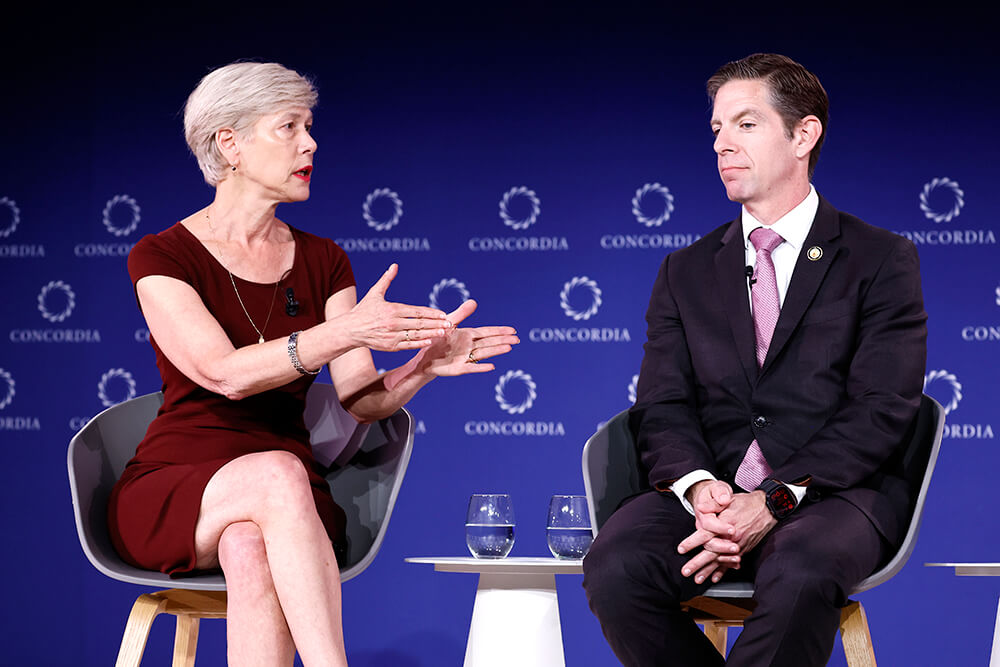
NEW YORK, NEW YORK – SEPTEMBER 21: (L-R) Rep. Deborah K. Ross (D-NC) and Rep. Mike Levin (D-CA) speak during the 2026 Concordia Annual Summit at Sheraton New York Times Square on September 21, 2026 in New York City. (Photo by Paul Morigi/Getty Images for Concordia Summit)

Important
Quotations

“We desperately need for the brightest minds to decide to sacrifice a bit and to serve a cause greater than their pocketbook and come work for the government and help create those rules of the road.”
The Hon. Mike Levin
“That integrated resource plan has got to have a forward look, not a backward look.”
The Hon. Deborah Ross

Key
Takeaways

  • High fuel prices are a top concern for constituents, with Levin citing $6.19 per gallon in California and a rise of about $1.30 per gallon since the Iran war began in late February, and Ross describing impacts on small businesses, contractors, and even Meals on Wheels volunteers. 
  • Both members, who are Democrats, blamed the administration’s Iran policy for the price spike and criticized the lack of a clear mission and of consultation with Congress, while Logothetis, noting that Republican invitees could not attend, presented the administration’s view that higher prices are a worthwhile cost of preventing a nuclear Iran and will fall once the war ends. 
  • Both members are promoting the Thriving Economy Project, an “all tools” approach to affordable and reliable energy that keeps natural gas as a bridge fuel while scaling up battery storage, geothermal, and small modular nuclear reactors, such as those being tested at Fort Bragg in North Carolina. 
  • Levin argued that economics, not regulation, ultimately drives the grid, and that the key question for the U.S. is whether it will manufacture the energy technologies of the future at home or import them from China, Europe, and Asia. 
  • There is real bipartisan common ground on energy, with Ross noting that most energy bills on advanced nuclear, geothermal, and battery storage pass the House Science Committee unanimously, and Levin pointing to a near-unanimous measure to keep ratepayers from bearing data center costs. 
  • On AI, both called for common-sense guardrails, with Levin proposing a regulator with enforcement power similar to the FAA or Nuclear Regulatory Commission and Ross noting more than 10 unanimous bipartisan AI bills ready for a floor vote, while opposing federal preemption of state laws on health and safety. 
  • Both members predicted Democrats would win the House in the midterms, with a prediction of around 230 seats, and Ross predicted a Democratic Senate pickup in North Carolina, while both acknowledged the Senate is less certain. 

Action
Items

  • Congress should bring the bipartisan energy bills on advanced nuclear, geothermal, and battery storage to a floor vote. 
  • Lawmakers should make protections that keep households from paying for data center energy costs mandatory rather than voluntary. 
  • States should update their integrated resource plans to take a forward-looking view, using natural gas as a bridge while expanding storage, nuclear, and other technologies. 
  • Policymakers should support domestic manufacturing of clean energy and grid technologies so the U.S. leads rather than relies on imports. 
  • Congress should advance the bipartisan AI bills already out of committee and consider creating a dedicated AI regulator with enforcement authority, while preserving state authority on health and safety issues. 
  • Government should actively recruit engineers and scientists into public service to help Congress write effective rules for energy and AI.