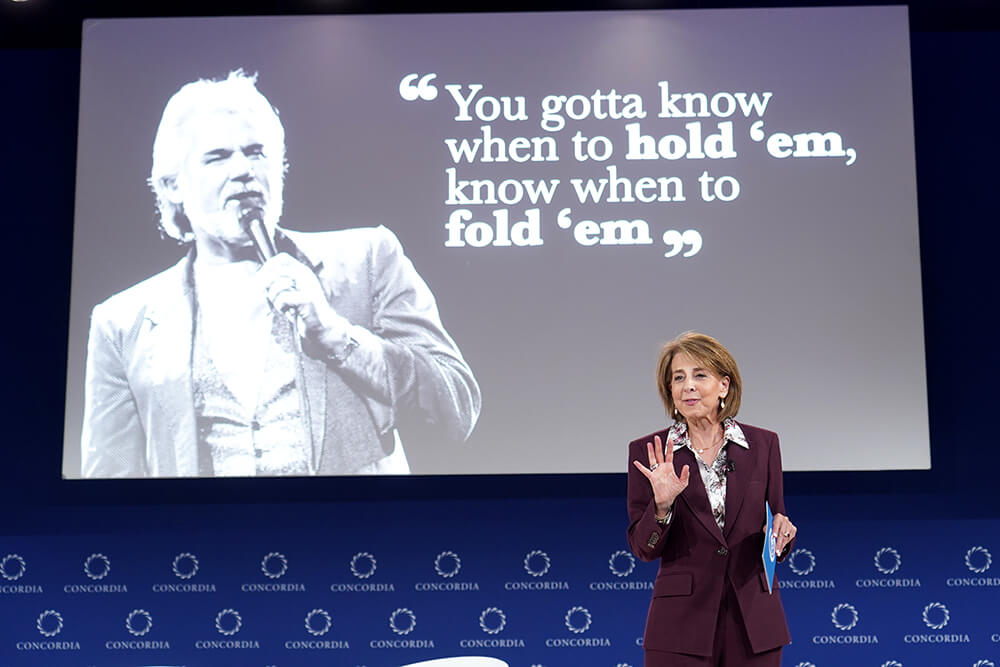
NEW YORK, NEW YORK – SEPTEMBER 22: Liz Schrayer, President and CEO of The US Global Leader Coalition, speaks during the 2026 Concordia Annual Summit at Sheraton New York Times Square on September 22, 2026 in New York City. (Photo by Leigh Vogel/Getty Images for Concordia Summit)
Important Quotations
“That’s how America can win. We can be great, and we can be good.”
Liz Schrayer
Key Takeaways
Dozens of reports and commissions on the future of international assistance are underway, with most due next year, and they broadly agree that effective assistance strengthens economic and national security.
With resources under pressure and global stakes rising, assistance has to be effective and agile, not just well-funded.
Five practices should be left behind: open-ended assistance without sunset plans (life-saving humanitarian aid excepted), aid disconnected from national interest, doing what a country can do for itself, duplication and bureaucratic silos, and under-investing in the capacity to deliver.
Funding often keeps flowing to programs that have already succeeded, and donors are slow to pivot when countries reach middle- or upper-income status.
Five principles should guide assistance going forward: alignment with national interests (security, jobs and economic growth, values), leveraging private capital, harnessing innovation including tech and AI, delivering measurable results, and building local self-reliance through burden-sharing.
The Lobito Corridor shows the model in practice. It pairs strategic critical-minerals infrastructure with community investments in health, food security, and governance, offering a win-win alternative to rivals’ “grab and go” approach.
Programs like PEPFAR show the human return on assistance, turning a homeless, HIV-positive teenager into a healthy, self-reliant entrepreneur.
Action Items
Use the USGLC blueprint as a starting framework for evaluating current assistance programs and future proposals.
Build sunset and transition plans into every new program, with clear success and exit criteria defined up front, while protecting life-saving humanitarian aid.
Audit existing portfolios for programs that have met their goals or countries that have graduated to higher income levels, and redirect those resources.
Coordinate across agencies such as State, DFC, and MCC to eliminate overlap and break down bureaucratic silos.
Invest in the people, systems, and institutional capacity needed to deliver programs efficiently.
Design programs that attract private capital, use technology and AI, and report measurable outcomes.
Require partner countries to contribute their own resources so they have skin in the game and move toward self-reliance.
Watch for the upcoming reports and the USGLC’s “report on reports” next year to identify the strongest ideas for adoption.