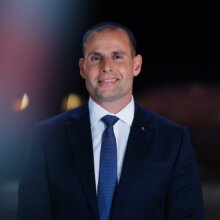
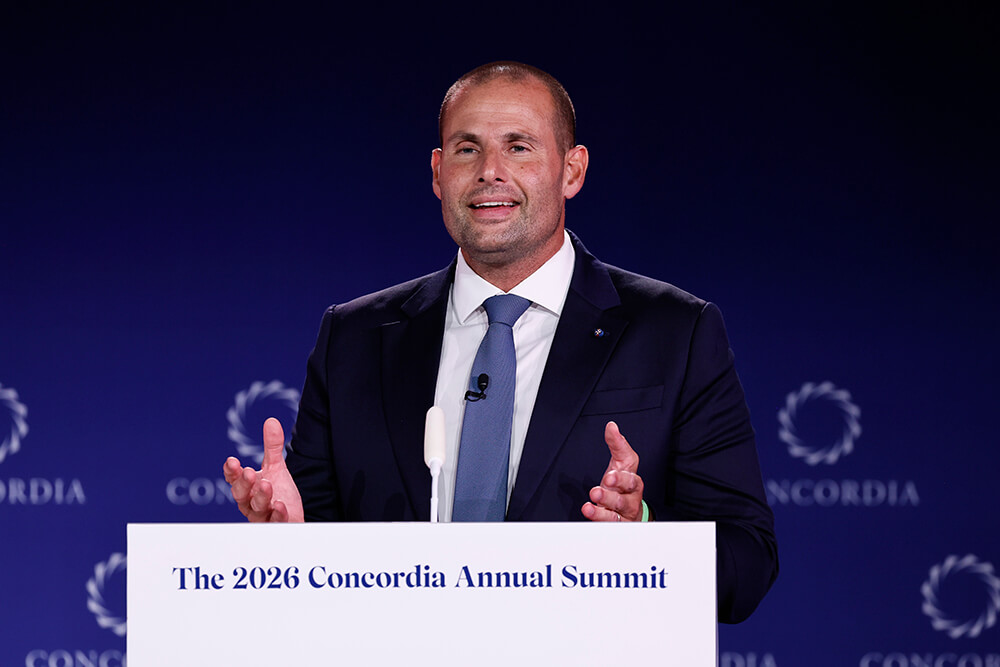
NEW YORK, NEW YORK – SEPTEMBER 22: H.E. Robert Abela, Prime Minister of the Republic of Malta, speaks during the 2026 Concordia Annual Summit at Sheraton New York Times Square on September 22, 2026 in New York City. (Photo by Paul Morigi/Getty Images for Concordia Summit)
Important Quotations
“Let us choose openness over fragmentation, partnership over isolation and shared prosperity over narrow advantage.”
H.E. Robert Abela
Key Takeaways
Prime Minister Abela said that for Malta, an island state at the heart of the Mediterranean, trade is not an abstract concept but the essential condition for its prosperity. With trade routes, supply chains, technology, and climate pressures all shifting, he argued the question is not whether the global economy will change but how countries shape that change with confidence.
He warned against equating resilience with self-sufficiency, arguing that “openness and security go hand in hand.” Countries need supply chains that can withstand shocks and partnerships that reduce vulnerabilities without new barriers, rather than defaulting to protectionism. He acknowledged that when prices rise, trade can feel distant or unfair to households, but said that without it people would face fewer choices and higher costs.
Abela described Malta, the EU’s smallest member state, as having diversified into tourism, advanced manufacturing, aviation, financial services, gaming, logistics, digital industries, and the maritime sector. Through Malta Vision 2050 and a new wellbeing index, he said Malta judges economic policy not only by headline figures but by how it improves people’s daily lives.
He said AI, data analytics, and digital trade give small economies the chance to compete through talent, agility, and ideas. The goal is for technological progress to “widen opportunity rather than deepen inequality,” backed by skills training and access to finance.
He presented the green transition as both an environmental necessity and an economic strategy. For an island nation, it is closely tied to energy security, maritime sustainability, and the responsible use of scarce resources.
Pointing to current shipping disruptions, Abela stressed that open trade routes depend on a predictable, rules-based international trading system, which gives smaller economies a fair chance to compete. Malta remains committed to multilateralism and sees itself as a gateway between Europe, North Africa, and the Middle East.
He said these transitions can’t be managed by governments or markets alone. Governments must provide vision and stability, businesses investment and innovation, and educators and civil society a focus on evidence, skills, and people’s needs. In an interconnected world, he warned, vulnerability “does not remain distant” but travels through supply chains, finance, and food and energy markets.
Action Items
Build resilient, diversified supply chains through international partnerships rather than defaulting to protectionism.
Judge economic policy by its effect on people’s daily lives, using tools such as wellbeing indices alongside traditional measures like GDP.
Pair investment in AI and digital infrastructure with skills training and access to finance, so small businesses and workers can compete globally.
Make the green transition part of national energy security and competitiveness strategies, especially for island and coastal economies.
Uphold a rules-based international trading system and work with partners to keep maritime trade routes open and reliable.
Strengthen cooperation between government, business, educational institutions, and civil society in managing economic change.