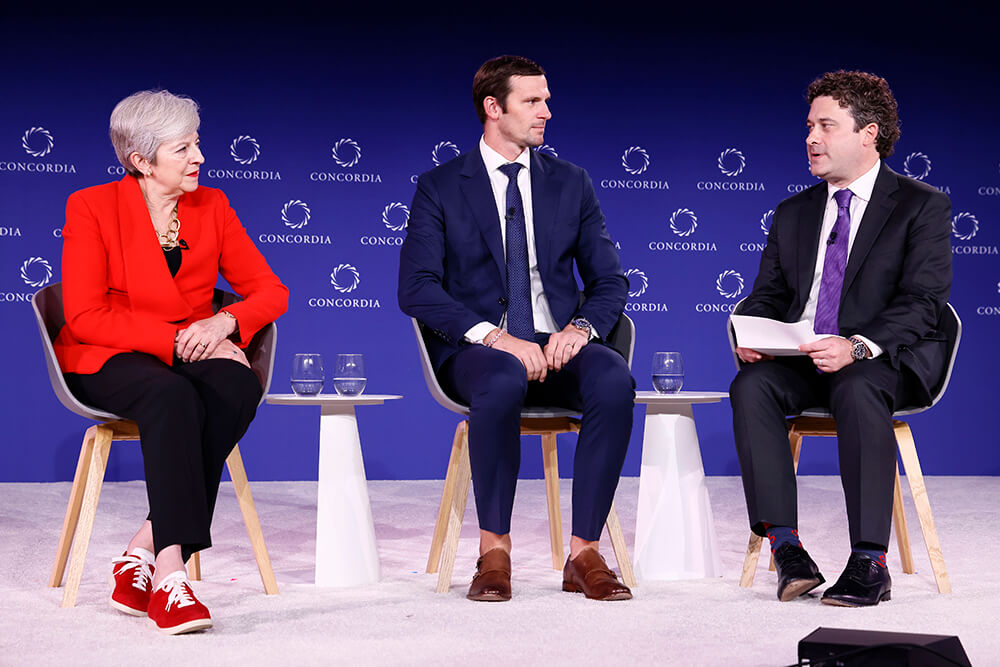
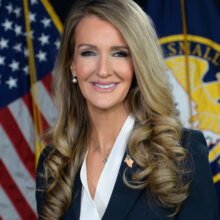
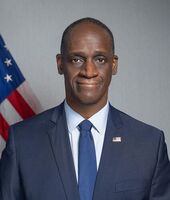
NEW YORK, NEW YORK – SEPTEMBER 22: (L-R) The Rt Hon. Baroness Theresa May, Former Prime Minister of the UK, The Hon. Rob Law, Under Secretary for Strategy Policy and Plans, and Josh Rogin, Journalist at The Washington Post, speak during the 2026 Concordia Annual Summit at Sheraton New York Times Square on September 22, 2026 in New York City. (Photo by Paul Morigi/Getty Images for Concordia Summit)
Important Quotations
“Economic security is homeland security.”
The Hon. Rob Law
“It is a matter of human dignity. It’s a matter about the freedom of individuals to be themselves.”
The Rt Hon. the Baroness Theresa May of Maidenhead
No country is immune. It will shock you, but you should not turn away.”
Josh Rogin
Key Takeaways
The Global Commission on Modern Slavery and Human Trafficking’s report, titled “No Country Is Immune,” found that over 50 million people are trapped in modern slavery, generating at least $236 billion in illicit profits a year, and May framed the issue as one of human dignity that also distorts trade competition and can be used by some states to destabilize others.
The Commission’s second phase focuses on putting its recommendations into practice by helping governments pass and enforce strong legislation, getting CEOs to commit to finding and addressing forced labor in their supply chains, urging humanitarian groups to address trafficking in crisis zones, and researching the business case for action, with commissioner and former Unilever CEO Alan Jope warning that any company that thinks it has no forced labor in its supply chain is wrong.
Law said the cost of noncompliance is rising under the current administration, with the Forced Labor Enforcement Task Force he chairs listing more entities than ever under the Uyghur Forced Labor Prevention Act, pursuing criminal as well as civil enforcement, and scrutinizing suppliers several tiers down the supply chain, because “economic security is homeland security.”
Rogin noted that Section 301 tariffs on forced labor could apply to about 60 countries that lack comparable protections, and Law said DHS recently met with representatives from 50 of those countries to help them reach compliance, which he said should have happened “yesterday.”
Law acknowledged that resources are a constraint, but said the government is relying on a whole-of-government approach, new information-sharing agreements with international partners, and public-private partnerships, with its Trade Fraud Task Force assessing over $1 billion in violations in its first year.
Rogin raised concerns that funding cuts for anti-trafficking NGOs and enforcement in the U.S., Europe, and elsewhere are shrinking the ecosystem doing this work, and May said she voted against her own party to try to protect the UK’s international development budget.
May stressed that slavery also happens inside countries like the UK and the U.S., so comprehensive legislation must support victims so they feel safe coming forward and help police and courts understand the issue and prosecute perpetrators.
Action Items
Businesses should map their supply chains down to the deepest tiers and act decisively when they find forced labor.
Governments should pass and enforce comprehensive modern slavery laws that cover domestic exploitation, support victims, and train police and the justice system.
Humanitarian organizations should treat human trafficking as a core risk when responding to disasters and conflicts.
Governments should expand information sharing with international partners and work with other countries to raise their forced labor standards.
Governments and funders should protect resources for anti-trafficking NGOs and enforcement, and expand public-private partnerships to fill gaps.
Individuals and organizations should raise awareness of modern slavery, starting by reading and sharing the Global Commission’s “No Country Is Immune” report.