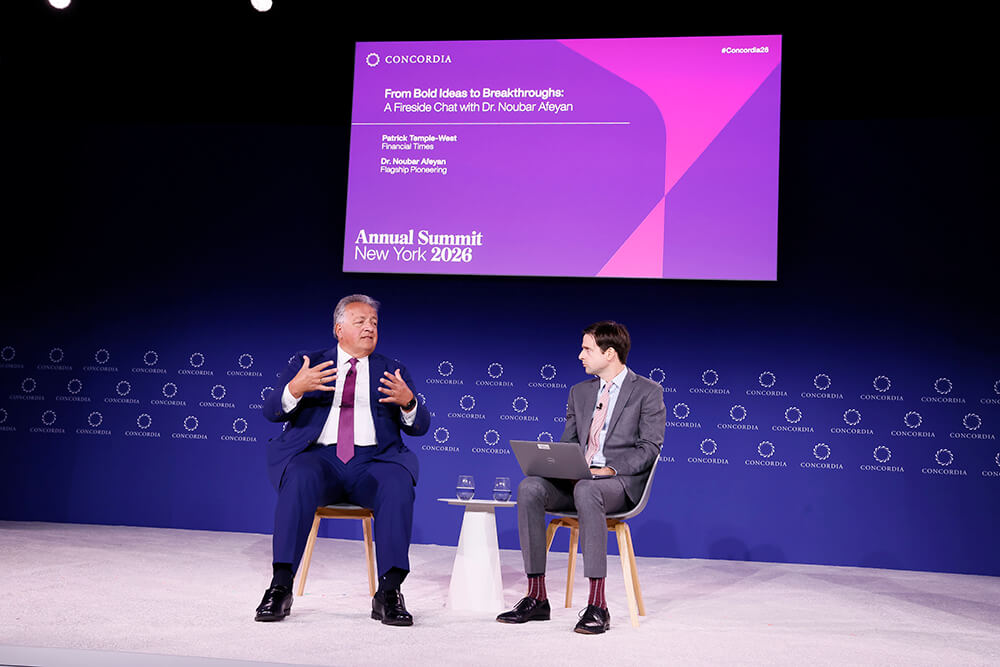
NEW YORK, NEW YORK – SEPTEMBER 21: (L-R) Noubar Afeyan, Founder & Ceo of Flagship Pioneering, and Patrick Temple-West, Journalist at Financial Times, speak during the 2026 Concordia Annual Summit at Sheraton New York Times Square on September 21, 2026 in New York City. (Photo by Paul Morigi/Getty Images for Concordia Summit)
Important Quotations
“The longer we stay in a learning mode and not in a conclusion mode, the better for where we are in science.”
Noubar Afeyan
Key Takeaways
Flagship Pioneering, now in its 26th year, creates companies from scientific breakthroughs made by its own in-house teams and has launched 125 companies, including Moderna, its 18th, and newer AI-focused companies like Lila Sciences and Generate Biomedicines.
Afeyan described AI in science not as a co-pilot for writing reports but as a “prosthesis” for discovery, since very large models may represent biological systems in ways the human brain cannot, and AI agents can run millions of efforts in parallel.
He called the debate over whether AI will speed up drug discovery a “wasted debate,” because the data will ultimately decide, and said the responsibility for building safeguards falls on scientists and engineers rather than policymakers.
Generate Biomedicines has computationally designed an antibody against the TSLP target that could be taken once every six months instead of every two weeks, now in late-stage phase 3 trials and possibly one of the first computationally generated drugs, though Afeyan stressed one result won’t prove or disprove the approach.
Lila Sciences is building autonomous scientific discovery, in which AI generates hypotheses, designs experiments, runs them with robots, analyzes the results, and repeats the loop, which could multiply the pace of science across biology, chemistry, and materials.
Moderna and Merck’s personalized mRNA cancer vaccine, designed from each patient’s own tumor DNA, improved recurrence-free survival in phase 2 trials by about 50% over the current standard of care for mid-to-late-stage melanoma five years later, with phase 3 results showing statistically significant gains and work underway on nine other cancers.
Afeyan warned that the scientific enterprise is under pressure from policy driven by opinion rather than fact, citing changes to NIH grant-making, and urged the scientific community to push back as if those pressures will intensify.
Action Items
Biotech and life sciences companies should build AI-enabled discovery systems that change the whole research process, rather than adopting AI only as an efficiency tool.
Scientists and engineers working on AI should take ownership of developing safeguards for the technology instead of waiting for policymakers.
Investors should commit patient, long-term capital to ambitious scientific bets, as with Moderna’s 10-year, $2.5 billion path to proving its platform.
Policymakers should sustain public investment in science and keep grant-making based on scientific merit and evidence.
The scientific and medical communities should speak up publicly and consistently in defense of fact-based science.
Regulators should prepare for new kinds of therapies, including computationally designed drugs and patient-specific treatments like personalized cancer vaccines.