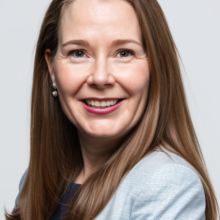
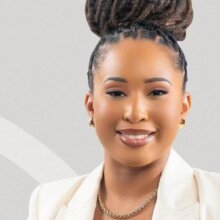
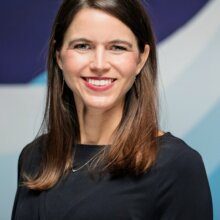
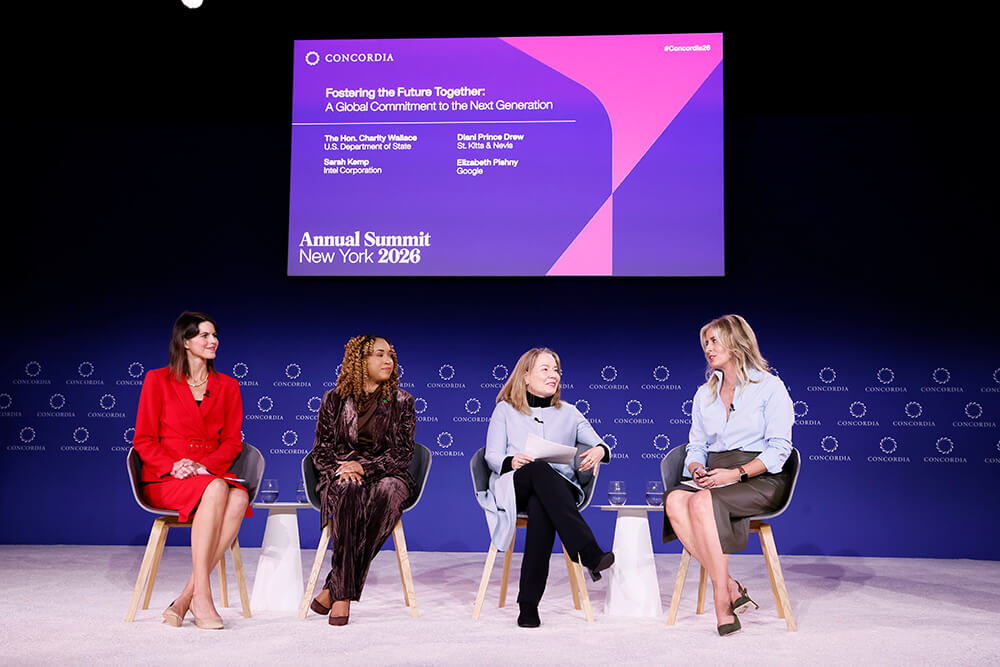
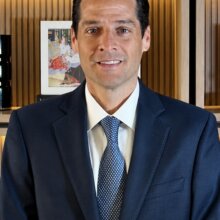
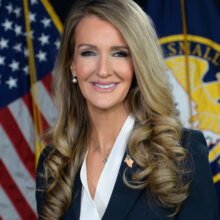
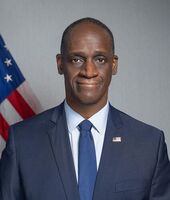
NEW YORK, NEW YORK – SEPTEMBER 21: (L-R) Elizabeth Pishny, Government Affairs at Google, Diani Prince-Drew, Spouse of the Prime Minister of St Kitts and Nevis, Sarah Kemp, VP International Government Affairs at Intel Corporation, and Charity Wallace, U.S. Special Envoy for Best Future Generations, speak during the 2026 Concordia Annual Summit at Sheraton New York Times Square on September 21, 2026 in New York City. (Photo by Paul Morigi/Getty Images for Concordia Summit)
Important Quotations
“The idea is to ensure that every child everywhere has the opportunity to reach their full potential through education, using advanced technology and beyond.”
The Hon. Charity Wallace
“We want to create that next generation that creates the app we didn’t even know we needed.”
Sarah Kemp
“St. Kitts and Nevis is the smallest nation in the Western Hemisphere. That does not mean that we’re looking for a handout. We’re simply looking for partnership.”
H.E. Diani Prince Drew
“We really believe it’s important to open up pathways for every type of worker.”
Elizabeth Pishny
Key Takeaways
The Fostering the Future Together coalition, launched by First Lady Melania Trump around last year’s UN General Assembly, now includes more than 57 first spouses and equivalent leaders and over 30 private sector partners, focused on four pillars: AI in education, ed tech tools, online protection of children, and digital skills.
Wallace stressed that no single government can prepare children for the digital era alone, and that the private sector acts as an accelerator, as shown at an event earlier that day where nine private sector partners made announcements involving more than 20 countries.
Prince Drew said St. Kitts and Nevis, the smallest nation in the Western Hemisphere, is not looking for a handout but for purposeful, sustainable partnerships that help children use technology effectively, responsibly, and safely.
Intel announced new commitments in 10 countries, including Egypt, Ghana, Israel, Kenya, Malaysia, Panama, Poland, South Korea, the UAE, and Vietnam, aimed at making students creators rather than just consumers of technology, and in Panama it is training 50,000 teachers in applied AI and providing AI PCs that keep student data secure on the device.
Google is deploying AI that acts as a “patient tutor” by asking guiding questions instead of giving answers, has partnered with over 400 universities so its AI certificates count toward degrees, is investing in libraries, rural community colleges, and apprenticeships for trades like electricians and plumbers, and announced $4 million to Digital Promise to provide free AI training for educators globally.
Teachers are central to this effort, especially in places where one teacher may serve 100 students, while lack of connectivity means that talented young innovators in many schools remain unseen, as shown by a 17-year-old in India who created a low-cost app that helped farmers use less fertilizer and increase crop yields.
St. Kitts and Nevis will host a Caribbean summit for Fostering the Future Together in early November, taking an all-of-society approach that includes civil society and students themselves.
Action Items
Governments, especially smaller nations, should form long-term, sustainable partnerships with tech companies through coalitions like Fostering the Future Together.
Governments and companies should invest in large-scale teacher training on AI so educators can confidently guide students.
Partners should expand connectivity and devices to underserved schools, using tools that keep student data secure.
AI education tools should be designed to build critical thinking, through guided prompting rather than giving answers, alongside training on responsible use and online safety.
Education systems should broaden pathways into AI-enabled careers, including certificates that count toward degrees, community college programs, and apprenticeships in the trades.
Policymakers should include young people directly in conversations about technology and education, as planned for the Caribbean summit in St. Kitts and Nevis.