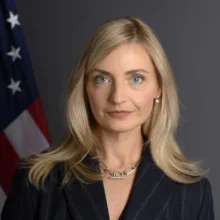
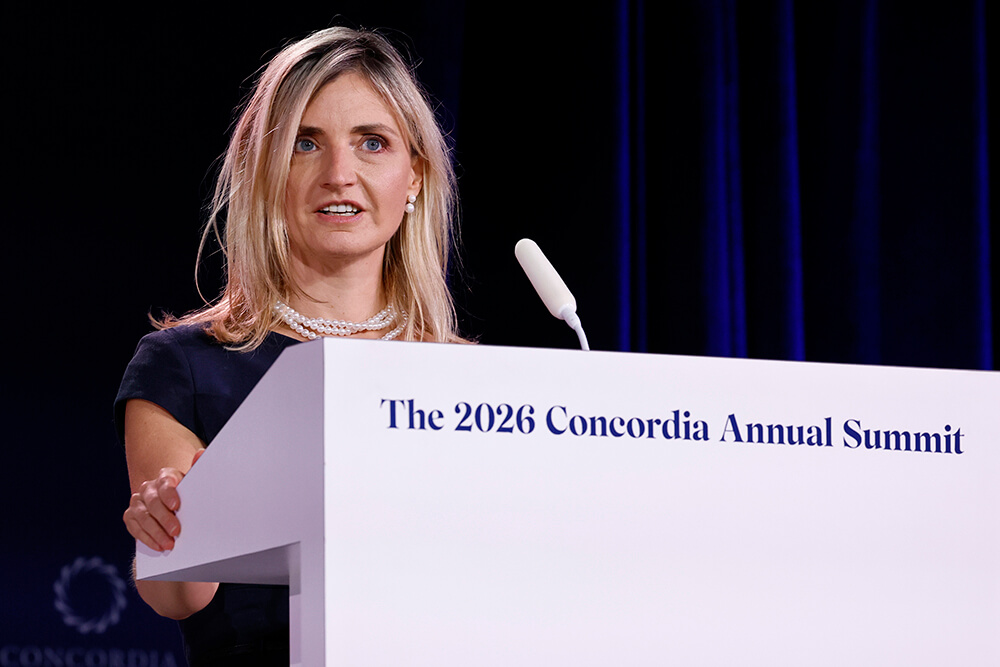
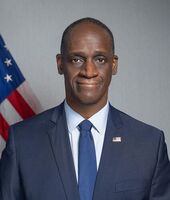
NEW YORK, NEW YORK – SEPTEMBER 21: Sarah Rogers, Under Secretary of State for Public Diplomacy, speaks during the 2026 Concordia Annual Summit at Sheraton New York Times Square on September 21, 2026 in New York City. (Photo by Paul Morigi/Getty Images for Concordia Summit)
Important Quotations
“I’m an artificial intelligence optimist. I think AI will unleash a golden age that will stretch the bounds of innovation and what is possible beyond anything we’ve experienced before.”
The Hon. Sarah Rogers
Key Takeaways
Under Secretary Rogers explained that public diplomacy covers America’s relationship with foreign publics, not just foreign governments, which puts her role at the center of the global information environment. She compared AI to the printing press and the telegraph as one of the rare shifts that change how people communicate.
She described herself as an AI optimist who believes it will unleash a “golden age” of innovation. She said AI’s future will be defined by who equips the world to innovate securely and what values underpin those systems. America’s “frontier” approach, setting guardrails without making innovators ask permission first, is in her view what has allowed the U.S. to lead.
A key goal of President Trump’s AI Action Plan is for American technology to become the trusted foundation of AI worldwide. She called American open-source and open-weight models an added strategic advantage, because developers can adapt them to local needs while building on American security and transparency.
She argued that cheaper foreign alternatives carry hidden long-term costs, including data exploitation, intellectual property theft, security vulnerabilities, and vendor lock-in. She also warned that AI models from authoritarian countries can spread censorship, surveillance, and political orthodoxy.
The main obstacle, she said, is access. In many emerging markets, compute costs and software licensing put American AI out of reach for entrepreneurs who want it, even though today’s startups there could become tomorrow’s global companies and long-term partners.
She announced AI Next, a new public-private partnership between the State Department, the Global Entrepreneurship Network, and U.S. companies. Companies will contribute training, certification courses, and compute credits, and U.S. embassies and consulates will connect those resources to startups and accelerators around the world.
She presented company participation as a business and foreign policy strategy rather than charity, since helping entrepreneurs build on American AI opens new markets and builds long-term loyalty to American platforms.
Action Items
U.S. AI companies and investors should join AI Next and contribute compute credits, API access, training, certification, or mentorship.
U.S. embassies and consulates should identify promising startups and accelerators in priority markets and connect them directly with AI Next resources.
Reduce cost barriers for entrepreneurs in emerging markets through affordable compute and flexible software licensing for early-stage companies.
Promote American open-source and open-weight models so local developers can adapt them to their own languages, markets, and priorities.
Help international entrepreneurs evaluate the full lifetime cost of the technology they adopt, including data security, intellectual property protection, and the risk of vendor lock-in.