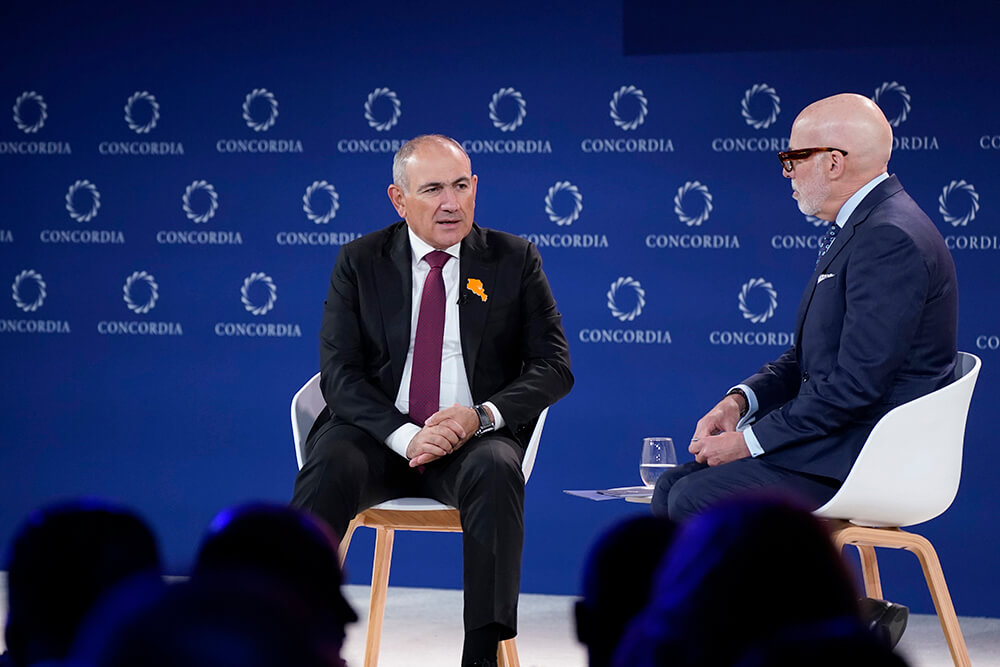
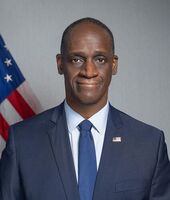
NEW YORK, NEW YORK – SEPTEMBER 22: (L-R) Nikol Pashinyan, Prime Minister of the Republic of Armenia, and Douglas Smith, Global Head of Public Affairs for The Nuclear Company, speak during the 2026 Concordia Annual Summit at Sheraton New York Times Square on September 22, 2026 in New York City. (Photo by Leigh Vogel/Getty Images for Concordia Summit)
Important Quotations
“When there is peace, there is stability, a kind of gravity for tourism is being created, and now Armenia really is becoming more and more attractive country for tourism.”
H.E. Nikol Pashinyan
“As your country cements peace in such an important part of the world, brings new kinds of jobs to your citizens, what do we have to look forward to?”
Douglas Smith
Key Takeaways
Implementation of the Trump Route for International Peace and Prosperity (TRIP) is the government’s main focus. It is expected to end a blockade in place since the early 1990s by opening a railway with Azerbaijan, and Armenia hopes it will also lead to an open border and rail link with Turkey.
TRIP will create a new east–west international trade route, and a parallel result will be a railway between the Persian Gulf and the Black Sea, bringing Armenia’s “Crossroads of Peace” vision closer to reality.
In the year since Armenia and the U.S. signed a memorandum of understanding on AI cooperation at the White House on August 8, Armenia has launched three AI centers. These include two AI factories, one of them a roughly $5 billion Firebird program with NVIDIA, which strengthens an IT sector that already drives a meaningful share of GDP growth.
Armenia’s large solar resources make energy self-sufficiency possible, but the country currently has no energy storage capacity, and building it is a top priority.
The Soviet-era nuclear power plant is nearing the end of its operating life, and Armenia is negotiating with the U.S., Russia, China, France, and South Korea to find the best proposal for a new plant.
Armenia follows a “balanced and balancing” foreign policy to protect its independence. It has strategic partnerships with the U.S., the EU, and China, and a 2025 law began the process of joining the EU. It has also diversified its oil imports to cope with volatility around Iran and the Persian Gulf.
Tourism grows directly with peace and stability, and visitors consistently name Armenian hospitality and warmth as the country’s biggest draw.
Action Items
Logistics, infrastructure, and trade firms should look at investment opportunities along the TRIP corridor and the planned Persian Gulf–Black Sea rail link.
Technology companies and investors should explore partnerships with Armenia’s growing AI ecosystem under the U.S.–Armenia AI cooperation framework.
Energy developers and investors should pursue grid-scale energy storage projects to pair with Armenia’s fast-growing solar capacity.
Nuclear technology providers, including U.S. firms, should prepare competitive proposals for Armenia’s next nuclear power plant while the decision is still open.
Governments and international partners should support opening the Armenia–Turkey border and rail link and efforts to stabilize the wider region.
Businesses entering the European market should engage with Armenia now and align with the regulatory direction of its EU accession process.
Tourism and hospitality stakeholders should invest in and market Armenia to European and American travelers, using the country’s reputation for hospitality.