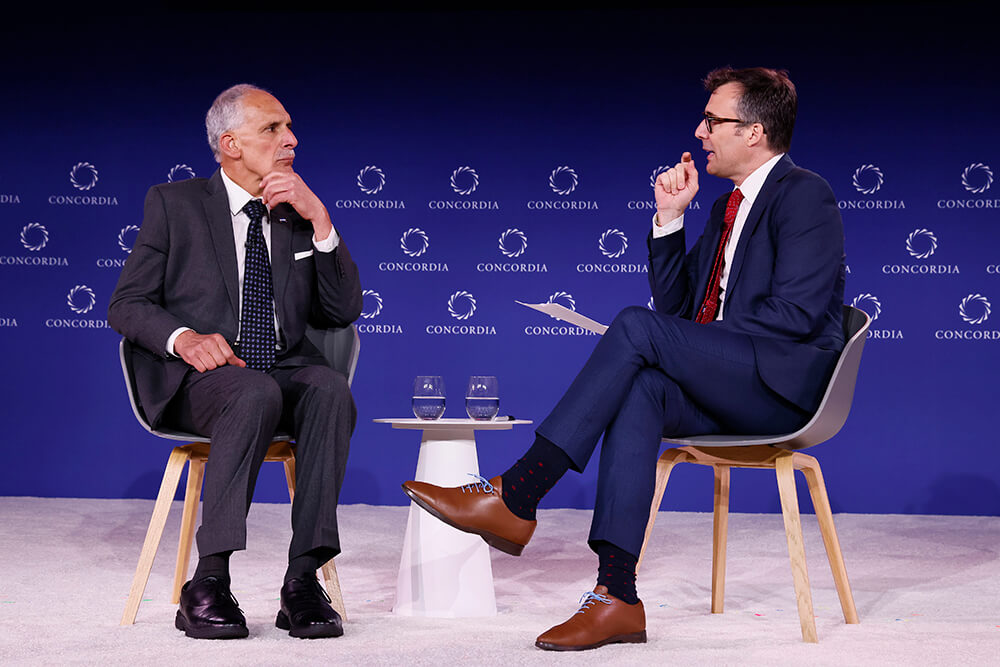
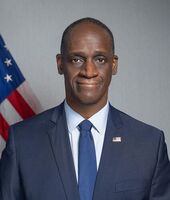
NEW YORK, NEW YORK – SEPTEMBER 21: (L-R) Nasry Juan Asfura, President of the Republic of Honduras, and Gustau Alegret, International Journalist & TV Anchor, speak during the 2026 Concordia Annual Summit at Sheraton New York Times Square on September 21, 2026 in New York City. (Photo by Paul Morigi/Getty Images for Concordia Summit)
Important Quotations
“We were chosen to work and serve and we shouldn’t get lost... To be able to serve people and to respond to people. That is what people need. That is what people expect.”
H.E. Nasry Juan Asfura
“We are in times of polarization and division or political fragmentation... Don’t you think you have to extend your hand to reach those agreements?”
Gustau Alegret
Key Takeaways
President Asfura said “political security,” meaning stable governance free of extremes, is his top priority because legal certainty, investment, and jobs all depend on it. He described his government as centrist, said the two main parties won about 81% of the vote and hold 93 of 128 congressional seats, and said jobs are what Hondurans ask for most. Alegret challenged him on whether calling future opponents “crazy people” helps build the cross-party agreements he needs.
On security, Asfura denied that his government is considering a state of exception. He said it is going after specific gang and drug-trafficking figures with long criminal records, while the courts and prosecutors uphold their constitutional rights. He also wants to train and equip the national and military police, and said he welcomes help from the U.S., the EU, or others.
He cited signs of economic stability: a fiscal deficit held near 1%, progress on IMF reviews with a new agreement in negotiation, reserves up $1.3 billion in seven months, currency depreciation under 2%, and $475 million in foreign investment in the first quarter. He added that a $700 million bond issue drew $2 billion in offers.
He called the U.S. Honduras’s most important partner. Honduras imports almost $6 billion from the U.S., exports almost $4 billion to it, and expects a record $13 billion in remittances this year, about 29% of GDP. He said U.S. tariffs have cost Honduras $530 million through July 31, and blamed the previous government’s denial of extradition and threats toward the U.S.
Honduras faces two major external shocks. Rising oil prices are pushing up fuel costs every week, and the government is subsidizing fuel to protect food and transport costs. Severe drought has put 104 of 298 municipalities on alert, with food aid going to as many as 100,000 families alongside UN agencies, and low water levels at major hydroelectric dams have forced a costly switch to diesel power.
Asfura wants Honduras to serve as a regional logistics hub. Plans include a new terminal at Puerto Cortés, upgrades to a Pacific port, an interoceanic road corridor linking the Atlantic and Pacific, and faster customs. On social policy, he highlighted health services that reach remote communities and 10 million school textbooks.
On corruption, he said a new anti-corruption law developed with the National Anti-Corruption Council and the Attorney General is close to completion, with an anti-bribery law to follow. He pledged to respect the independence and budgets of other branches, and committed to full transparency in the investigation of his former campaign advisor, Fernando Cerimedo. He closed by describing his presidency as service rather than ego.
Action Items
Build cross-party agreements and stable institutions so investors trust that policies will last beyond one election cycle.
Carry out targeted operations against gangs and drug trafficking with clear legal safeguards and independent oversight, and invest in police training and equipment with international partners.
Pass the anti-corruption and anti-bribery laws, guarantee the international anti-impunity commission’s independence and funding, and share information openly in politically sensitive investigations.
Negotiate with the U.S. to reduce tariff costs while expanding trade with the EU and other markets, and keep fiscal discipline under the IMF program.
Advance the Puerto Cortés expansion, Pacific port upgrades, the interoceanic corridor, and customs reform, using public-private partnerships to attract investment.
Strengthen resilience to climate and energy shocks by expanding drought response and food security programs with UN agencies and diversifying energy sources beyond rain-dependent hydropower and diesel.