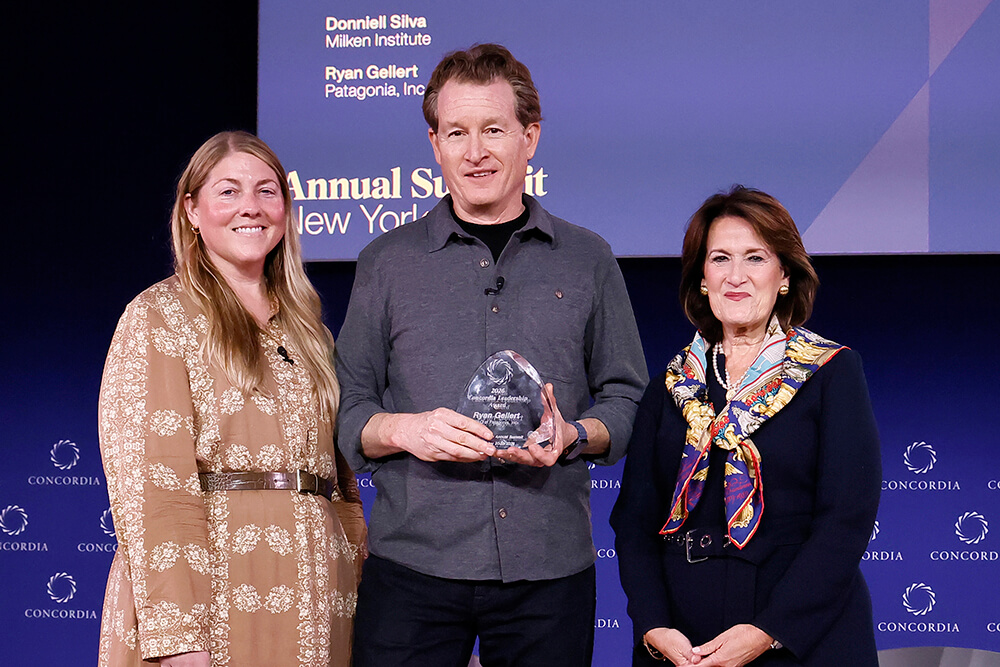
NEW YORK, NEW YORK – SEPTEMBER 21: (L-R) Donniell Silva, Managing Director of Global Programming at Milken Institute, Ryan Gellert, CEO of Patagonia, and Anita McBride, Executive in Residence at American University, pose onstage during the presentation of the 2026 Concordia Leadership Award at the 2026 Concordia Annual Summit at Sheraton New York Times Square on September 21, 2026 in New York City. (Photo by Paul Morigi/Getty Images for Concordia Summit)
Important Quotations
“Meaningful and sustainable progress requires leaders willing to engage across sectors, borders, and ideologies.”
The Hon. Anita McBride
“Leadership is standing up and being counted when things are really difficult. And they are really difficult right now.”
Ryan Gellert
“You’ve been willing... to be up front and outspoken about a very authentic perspective... especially at a moment in history where it’s much easier path to take to be quiet.”
Donniell Silva
Key Takeaways
McBride said the Concordia Leadership Award, created in 2012, honors leaders who turn vision into action and inspire purposeful leadership beyond their own institutions. This year’s honorees are Ryan Gellert (private sector), Laurie Patton (civil society), and María Corina Machado (public sector).
Patagonia’s ownership model was inspired by Yvon Chouinard’s friends Doug and Kris Tompkins, who used Doug’s fortune from Esprit to build national parks. A perpetual purpose trust holds Patagonia’s voting shares and safeguards the company’s values, while its financial shares sit in a set of 501(c)(4) organizations. Each year, profits go first to reinvestment and maintaining independence, and the rest is directed to protecting the environment. Before the change, the company gave $12 to $15 million a year through 1% for the Planet.
Yvon Chouinard asked Gellert to design this structure in the middle of COVID, soon after he became CEO in 2020, even threatening to start “cold calling billionaires” to find a buyer if he didn’t. The 12- to 18-month process involved emotional family meetings that narrowed many goals down to two: keep running the business by its values, and fund environmental protection at much greater scale now.
Gellert argued that the main mistake companies make is waiting until they have everything worked out, when “progress over perfection” is what drives impact. He distinguished businesses that do the minimum to appear responsible from those that commit to a hard, never-ending journey. At least one other company, Grady-White Boats, has followed Patagonia’s example.
He said businesses can do more as partners than as funders. In Albania, Patagonia helped bridge a long standoff between the government and conservationists to create the Vjosa Wild River National Park, Europe’s first wild river national park. He contrasted this with Patagonia’s second lawsuit against the Trump administration over shrinking Bears Ears National Monument, which is significant to five tribes.
On leadership, Gellert said he loves “doing hard things with great people” and credited his mother’s big heart as a key influence. Patagonia hires for selflessness, curiosity, and a desire to be part of something bigger, not necessarily environmentalists. He believes leadership means standing up when things are hardest, and said Patagonia will be active ahead of the midterm elections.
His advice to young leaders was to find what truly energizes them and commit to it, remembering that “I’m dropping by for a cup of coffee” and the goal is to leave things better than you found them. He shared that his most treasured memory is taking his 10-year-old son to Bears Ears with tribal members on the day its boundaries were restored, instead of attending the White House ceremony.
Action Items
Business leaders should prioritize “progress over perfection,” making ambitious environmental and social commitments now and raising them over time.
Founders and family owners should consider purpose-driven ownership structures, such as perpetual purpose trusts, when planning for succession.
Companies should partner with governments, civil society, and Indigenous communities on conservation by contributing expertise and problem-solving, not just funding.
Organizations should hire for values such as selflessness, curiosity, and commitment to a larger purpose, alongside technical skills.
Leaders should be willing to speak up on issues tied to their organization’s mission, especially when it is difficult.