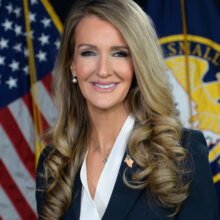
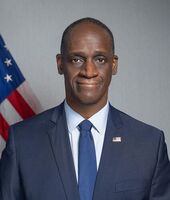
NEW YORK, NEW YORK – SEPTEMBER 22: (L-R) Laurie Patton, President at the American Academy of Arts & Sciences, accepts the 2026 Concordia Leadership Award from Bart Friedman, Chairman at Giant Eagle Enterprises, during the 2026 Concordia Annual Summit at Sheraton New York Times Square on September 22, 2026 in New York City. (Photo by Paul Morigi/Getty Images for Concordia Summit)
Important Quotations
“The beginning of democracy is in convening, and the persistence of democracy is in the persistence in convening.”
Laurie Patton
“Meaningful progress requires collaboration, conviction, and a willingness to engage across traditional boundaries.”
Bart Friedman
Key Takeaways
Friedman nominated Patton for the 2026 Concordia Leadership Award for Civil Society. He cited her record as a scholar, poet, the first woman president of Middlebury College, and now president of the American Academy of Arts & Sciences, founded in 1780 by John Adams and others. He called her an indispensable advocate for institutions of learning at a time when they face profound challenges, and Patton opened by stressing that democracy begins and endures through people convening.
Patton described her idea of “pragmatic pluralism”: values can’t be negotiated, but ways of living together can, and one religion often needs another to be fully itself. She illustrated it with a Stern College student who sat a Jewish vigil (shmira) beside a refrigerated truck holding 9/11 victims’ remains, drawing mourners of every faith. She said interfaith cooperation tends to form around mourning, care of buildings, food, the arts, and increasingly the environment.
For university leaders, Patton said the deeper issue isn’t distrust of higher education, since trust in local institutions remains strong. It’s people asking why they should take part in institutional life at all, along with a widespread feeling that “the system is someone else.” With AI moving too fast for statements to keep their meaning, she urged leaders to return to core principles and the value of a liberal education.
She said effective leadership has shifted from command and control toward accessibility, authenticity, and vision, including admitting mistakes, along with the ability to make clear decisions quickly.
At Middlebury, Patton launched a Conflict Transformation Initiative that treats managing conflict as a core part of education, like writing or speaking. She is applying the same approach at the Academy, whose founding mission is to advance the “interest, honor, dignity, and happiness of a free, independent, and virtuous people.” She plans to commission essays on each of those now-contested words for the Academy’s 250th anniversary in 2030, noting its founders gathered during the worst year of the Revolutionary War.
Every Academy project now aims to strengthen democracy, building on its 2020 report Our Common Purpose, several of whose proposals are now before Congress. Pointing out that 85% of state legislation is bipartisan, she said the Academy is learning from local communities and developing a program to honor local people who have transformed their communities through their knowledge, regardless of credentials.
On the divide between the military and academia, Patton said the military understands institutions, authority, and making decisions under extreme pressure, which she sees as valuable lessons for today’s culture. The Academy is launching a podcast whose first guests include General Jim Mattis, whose leadership lessons resonate across political lines.
Action Items
Institutions and civic organizations should keep convening people across political, religious, and ideological divides.
Colleges and universities should treat conflict transformation skills as a core part of education, alongside writing and speaking.
University and institutional leaders should prioritize accessibility, authenticity, and clear vision, openly admit mistakes, and anchor their response to AI in core principles.
Encourage interfaith cooperation around shared practices such as mourning, food, the arts, and environmental care.
Recognize and learn from local knowledge and bipartisan state-level work, including honoring community leaders whatever their credentials.
Narrow the civil-military divide by bringing ROTC, veterans, and military leadership lessons more fully into higher education.
Policymakers and civic groups should engage with the democracy-renewal recommendations in the Academy’s Our Common Purpose report.